Battery Formation & Grading Explained: Why the First Charge Decides Cell Quality
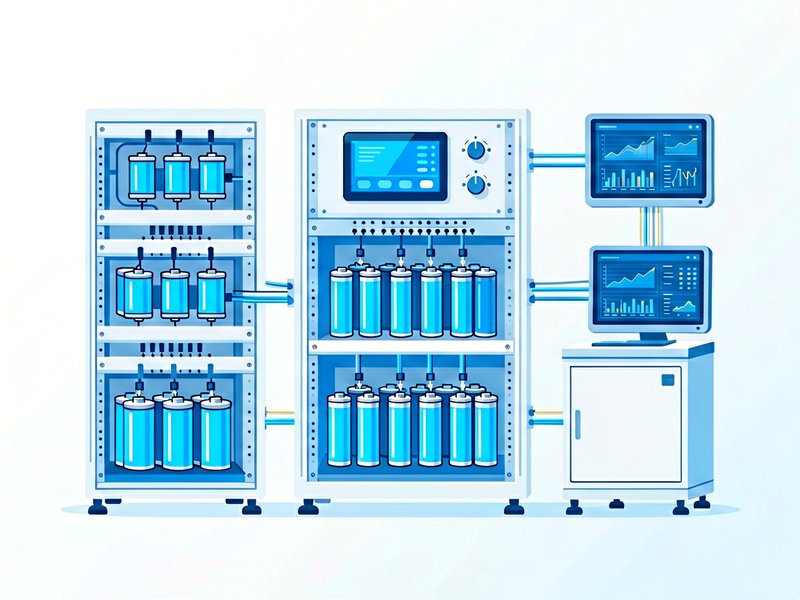
The first charge of a lithium cell shapes its entire life. Here is how formation and grading work, why they cost so much energy — and why energy recovery changes the economics.
Formation is the step where a freshly assembled lithium cell becomes a working battery. It is also one of the most energy-intensive steps in cell manufacturing, and the step that most strongly determines capacity, impedance and lifetime consistency. This article explains what happens physically, how grading sorts cells, and how modern formation & grading systems keep the process fast, accurate and affordable.
What Happens During Formation
When a lithium cell is first charged, the electrolyte reacts with the anode surface to form the solid electrolyte interphase — the SEI layer. This nanometer-thin film is the cell's most important protective coating: it must pass lithium ions while blocking further electrolyte decomposition. A poor or uneven SEI leads to accelerated aging, gas generation and early failure.
Formation therefore uses carefully programmed charge profiles — often multi-step constant current/constant voltage sequences with rest periods — to grow the SEI slowly and uniformly. The cell may be formed at elevated temperature, in specialized aging rooms, or under pressure for certain prismatic designs. Every profile parameter is logged per cell because it becomes part of the traceable quality record.
Why Formation Consumes So Much Energy
Formation charges every cell to near full state of charge, then typically discharges and recharges it one or more times to verify capacity. In a plant producing millions of cells a day, that is an enormous amount of electrical energy — and if discharge energy is dissipated as heat, the plant pays for it twice: once to produce the energy and once to air-condition it away. This is the core argument for regenerative formation equipment, which returns discharge energy to the grid or reuses it to charge other cells.
Grading: Sorting Cells by Performance
After formation, every cell is graded — measured and sorted so that cells with similar capacity, internal resistance and self-discharge end up in the same bin. This matters enormously downstream: a battery pack assembled from mismatched cells is limited by its weakest cell, wasting the capacity of the rest. Grading criteria usually include:
- Capacity (Ah): measured at a defined rate and temperature
- Internal resistance (mΩ): DC-IR or AC-IR at standard conditions
- Open-circuit voltage stability: an indicator of self-discharge rate
- Thickness/visual checks: for swelling or other anomalies
An integrated grading station combines a high-density cycler with an internal resistance tester, pushing each cell through a short test sequence and automatically binning it. VoltTest grading systems typically bin cells into 3–6 classes with configurable thresholds per customer specification.
Formation and Grading in the Production Flow
A typical cell plant layout places formation as one of the longest steps in the process — cells may spend hours on the formation floor. Modern formation & grading systems address this with high channel density (hundreds of channels per rack), precise current control for low-current formation stages, and energy recovery across the whole line. The payoff is threefold: shorter cycle time per cell, lower energy cost, and tighter grading that improves pack yield for your customers.
What to Ask When Buying a Formation System
- What is the current accuracy at low currents (C/20 and below)?
- Is energy recovery available on both charge and discharge paths?
- Can the system log per-channel data for the full formation duration?
- Does the channel voltage/current range cover your next cell design?
- How does the grading algorithm handle binning and yield reporting?
Next Steps
- Explore the formation & grading system range.
- See how formation connects to cycler selection.
- Request a quotation with your cell specs and annual output target.