How to Choose a Battery Charge/Discharge Test System: 7 Key Parameters
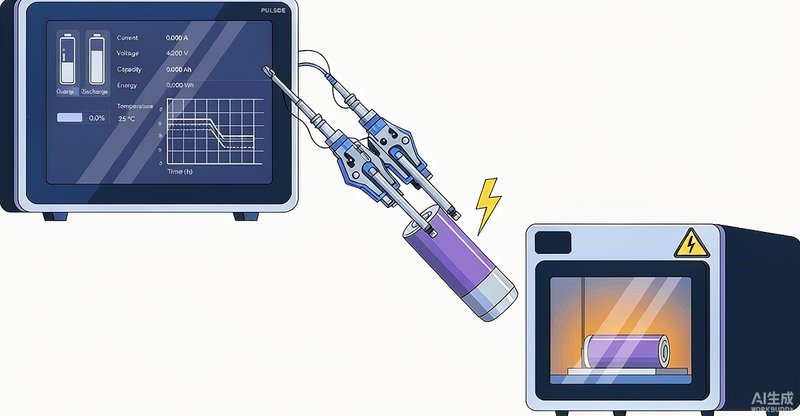
A battery cycler is a long-term investment that quietly defines the quality of every test you run. Here are the seven specification questions to settle before you compare quotations.
Charge/discharge test systems — often called battery cyclers — are the workhorse of every battery laboratory and production line. Yet a quoted spec sheet can look identical at a glance and differ hugely in practice. The seven parameters below are the ones our application engineers are asked about most, and the ones that most often drive the final buying decision.
1. Voltage Range vs. Actual Need
Match the cycler's voltage range to the cell types you test today — plus one upgrade step. A cell cycler commonly spans 0–5 V to cover Li-ion (nominal 3.2–3.7 V), while high-voltage packs may need 60 V, 200 V or more per channel. Buying only what you need now saves cost; leaving zero headroom forces an early upgrade. Most VoltTest cyclers offer 0–5 V, 5–12 V, 12–60 V and higher modular ranges on the same cabinet.
2. Current Accuracy: Where the Real Cost Is
Accuracy is usually quoted as a percentage of reading plus a percentage of full scale (e.g. ±0.05% RD ±0.05% FS). The full-scale term matters more than it looks: on a 100 A channel, a 0.05% FS error is 50 mA, which can dominate low-current test stages like trickle charge or C/50 capacity checks. If your work includes very low currents, ask about dual-range or auto-range channels before signing.
3. Channel Count and Cabinet Density
Channel density decides your lab footprint. A formation or cell-testing line may pack 512 channels into one rack, whereas module test stations run a handful of high-current channels. Ask for the wattage per channel and the total rack power, and verify cooling is designed for continuous full-load operation — a common failure point in budget cyclers.
4. Energy Recovery: The Operating-Cost Differentiator
When discharge energy is burned as heat, a large lab can spend a small fortune on electricity and air conditioning. Regenerative cyclers feed discharge energy back to the grid or to charge neighboring channels, cutting power consumption by up to 60–80% in formation and cycle-life operations. If you run long cycle-life tests around the clock, energy recovery pays for itself quickly. Our formation & grading systems are all energy-recovery designs for this reason.
5. Control Software and Data Management
The cycler hardware runs the chemistry; the software runs your lab. Look for: flexible step programming (current, voltage, power and resistance control), safety limits with hard cutoff, data logging at sub-second intervals, and an export path to common formats. For multi-station labs, verify the software supports batch scheduling and centralized monitoring — test technicians should not have to walk the aisles to check status.
6. Measurement Channels and Auxiliary Inputs
Modern testing rarely stops at voltage and current. Temperature channels for thermal characterization, auxiliary voltage inputs for reference electrodes or cell-level taps in module tests, and digital I/O for chamber or relay control all extend what a single test station can do. Decide which auxiliaries your test plans actually use — retrofitting later is more expensive than ordering them upfront.
7. Total Cost of Ownership, Not Just Price
Compare three numbers: purchase price, energy cost per year, and expected calibration/service interval. A cycler that saves 60% on electricity and holds calibration accuracy twice as long frequently beats a cheaper unit over five years. Ask the supplier for references with your cell type and for their calibration turnaround time — downtime in a production lab is billed in lost throughput.
Next Steps
- Explore the VoltTest charge/discharge test system range.
- See how cyclers fit into full lithium battery testing solutions.
- Request a quotation with your seven-point checklist.
12. Frequently Asked Questions
- ✓What is the typical accuracy requirement for my application? Most R&D labs require ±0.05% FS for cycle life testing. For production line QC, ±0.1% FS may be sufficient. Always match accuracy to your test requirements.
- ✓How often should test equipment be calibrated? Annual calibration is standard for most applications. Heavy-use labs (≥16 hrs/day) should calibrate every 6 months. ISO 17025 accreditation is recommended.
- ✓Can I use one system for both cells and packs? Yes, modular systems like VT-CDS can be configured with different voltage ranges. Ensure the cabinet has sufficient channel density and power supply capacity.
- ✓What about energy recovery efficiency? Modern regenerative cyclers achieve 90-95% energy recovery. This can reduce electricity costs by 60-80% during formation and cycle life testing.