ACIR vs DCIR: Choosing the Right Internal Resistance Measurement Method
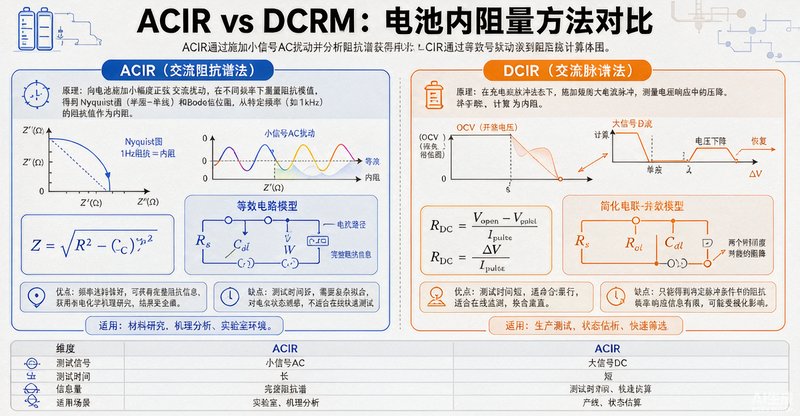
ACIR and DCIR look like the same number on a spec sheet, but they measure fundamentally different electrical properties. Understanding the difference is essential for cell matching, production sorting and quality acceptance.
1. What ACIR and DCIR Actually Measure
ACIR (AC Internal Resistance) applies a small sinusoidal signal at a fixed frequency — typically 1 kHz — and measures the impedance magnitude. This isolates the ohmic component of the cell's impedance from electrochemical polarization effects. DCIR (DC Internal Resistance) applies a brief DC pulse (typically 10 ms to 2 s) and calculates resistance from the voltage change (ΔV/ΔI), capturing both ohmic and polarization resistance. The difference between ACIR and DCIR values on the same cell can be 30–50% or more.
2. Test Time: Speed vs. Completeness
ACIR measurement is extremely fast — typically under 50 ms per cell — because it only needs one sine wave cycle at 1 kHz. This makes it ideal for high-throughput production sorting where millions of cells pass through an inspection station. DCIR takes longer because it requires charging the cell to a known state of charge, applying the pulse, and allowing the cell to stabilize. A typical DCIR measurement cycle takes 1–10 s per cell.
3. Which Method to Use Where
Use ACIR for incoming inspection and high-speed sorting on the production line — its speed and repeatability make it the standard for cell matching in formation and grading. Use DCIR for cell health assessment, state-of-charge estimation validation and quality acceptance testing — its capture of polarization resistance gives a more complete picture. Many OEM specifications require both: ACIR for batch acceptance and DCIR for sample-based quality verification.
4. Combined ACIR + DCIR Testing
A complete cell characterization workflow typically runs ACIR first (fast, high throughput) and then DCIR on a subset of cells (detailed, lower throughput). VoltTest's VT-IR series testers support both measurement methods on the same instrument, allowing seamless transitions between production sorting and quality verification without moving cells between stations.
5. Equipment Requirements
For ACIR testing: a 1 kHz signal source, precision shunt or current transformer, and a data acquisition system with sufficient bandwidth (≥10 kHz). For DCIR testing: a controlled DC current source, precision voltage measurement, and timing control for the pulse. A combined ACIR/DCIR instrument typically occupies one 19-inch rack unit and integrates all measurement paths into a single user interface.
12. Frequently Asked Questions
- ✓What is the typical accuracy requirement for my application? Most R&D labs require ±0.05% FS for cycle life testing. For production line QC, ±0.1% FS may be sufficient. Always match accuracy to your test requirements.
- ✓How often should test equipment be calibrated? Annual calibration is standard for most applications. Heavy-use labs (≥16 hrs/day) should calibrate every 6 months. ISO 17025 accreditation is recommended.
- ✓Can I use one system for both cells and packs? Yes, modular systems like VT-CDS can be configured with different voltage ranges. Ensure the cabinet has sufficient channel density and power supply capacity.
- ✓What about energy recovery efficiency? Modern regenerative cyclers achieve 90-95% energy recovery. This can reduce electricity costs by 60-80% during formation and cycle life testing.