LFP vs NMC Battery Testing: Key Differences Every Lab Should Know
LFP and NMC dominate the global lithium battery market, but testing them requires different voltage ranges, current profiles and safety considerations. Using NMC test protocols for LFP cells — or vice versa — produces misleading data and can damage equipment.
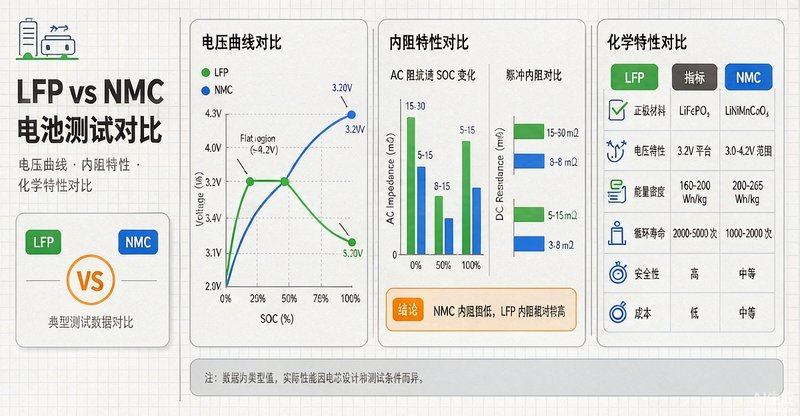
1. Voltage Range and Measurement Windows
LFP cells have a flat discharge curve centered around 3.2 V (3.0–3.65 V range), while NMC cells operate at 3.0–4.2 V (some variants up to 4.35 V). NMC cyclers need wider voltage headroom — a cycler configured only for LFP's 0–5 V range will not safely test NMC cells above 3.65 V. The flat LFP voltage curve makes state-of-charge estimation harder and requires current integration (coulomb counting) rather than voltage-based SOC estimation.
2. Internal Resistance Profiles
LFP cells typically have higher internal resistance (30–60 mΩ for 18650 cells) compared to NMC (15–30 mΩ). Testing both chemistries on the same line requires either auto-range instruments or separate testers optimized for each. A cell whose IR is near the top of the tester's range will have poorer resolution than one in the middle of the range.
3. Thermal Behavior During Testing
LFP cells generate less heat during charge and discharge at the same current. However, LFP's flat voltage curve means end-of-discharge is harder to detect — over-discharging LFP cells below 2.5 V can cause permanent copper dissolution. NMC cells have a more gradual voltage drop, making termination easier to implement. LFP's higher thermal stability threshold (typically 270 °C vs 200 °C for NMC) means the test chamber must handle different peak temperatures.
4. Formation and Grading Differences
LFP formation typically requires more cycles than NMC to achieve stable SEI formation. The voltage plateau at ~3.2 V during LFP formation requires longer hold times at constant voltage (CV). NMC formation is faster but requires more precise current control due to the more active cathode chemistry. Grading criteria also differ: LFP is graded by capacity and self-discharge, while NMC adds ACIR as a key sorting parameter.
5. Safety Test Requirements
Both LFP and NMC require the same core safety tests per UL 1642, IEC 62133 and GB 31241. LFP cells are more resistant to thermal runaway and typically exhibit a slower failure mode, while NMC cells can reach higher temperatures more quickly. Safety test chambers for dual-chemistry labs should be rated for the higher temperature extremes of NMC testing.
6. Equipment Configuration for Dual-Chemistry Labs
Labs testing both LFP and NMC should configure cyclers for the wider voltage range (0–5 V or higher), use auto-range IR testers, and specify safety test chambers covering both chemistries. VoltTest's VT-CDS series cyclers and VT-IR series testers are all configurable for both chemistries through software settings, eliminating the need for separate instrument sets.
7. Formation and Grading Differences
LFP formation typically requires more cycles than NMC to achieve stable SEI formation. The voltage plateau at ~3.2 V during LFP formation requires longer hold times at constant voltage (CV). NMC formation is faster but requires more precise current control due to the more active cathode chemistry. Grading criteria also differ: LFP is graded by capacity and self-discharge, while NMC adds ACIR as a key sorting parameter.
8. Safety Test Requirements Summary
Both LFP and NMC require the same core safety tests per UL 1642, IEC 62133 and GB 31241. However, the expected behavior differs: LFP cells are more resistant to thermal runaway and typically exhibit a slower failure mode, while NMC cells can reach higher temperatures more quickly. This means safety test chambers for dual-chemistry labs should be rated for the higher temperature extremes of NMC testing.
9. Equipment Configuration for Dual-Chemistry Labs
Labs testing both LFP and NMC should configure cyclers for the wider voltage range (0–5 V or higher), use auto-range IR testers, and specify safety test chambers covering both chemistries. VoltTest's VT-CDS series cyclers and VT-IR series testers are all configurable for both chemistries through software settings. Additionally, labs should calibrate IR testers for the resistance range of each chemistry, as LFP cells typically have higher internal resistance (30–60 mΩ for 18650 cells) compared to NMC (15–30 mΩ).
10. Recommendations for Labs Transitioning from Li-ion to Na-ion
While this article focuses on LFP vs NMC, labs transitioning from Li-ion to Na-ion testing should: (1) update cycler software with Na-ion voltage profiles, (2) design custom formation protocols in consultation with cell manufacturers, (3) calibrate IR testers for the Na-ion resistance range, (4) verify safety test chamber temperature profiles, and (5) establish capacity and cycle life baselines for Na-ion cells.