The Battery Formation Process: SEI Formation and Its Impact on Cell Quality
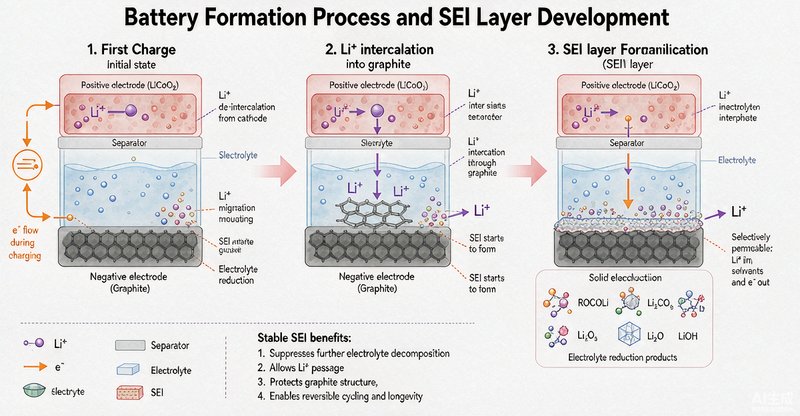
The first charge cycle of a lithium-ion cell is the single most important event in its life. What happens during formation determines how well the cell will perform, how long it will last, and how safe it will be in the field.
1. Why Formation Is Irreplaceable
A fresh lithium-ion cell comes off the production line with an inactive, disordered structure. The graphite anode surface is bare and reactive. Without formation, the cell would short out or self-discharge rapidly when exposed to charge. Formation activates the cell electrochemistry by carefully cycling it through controlled charge and discharge stages at precise currents and voltage limits.
2. SEI Formation: The Chemistry Behind It
During the first charge, lithium ions from the cathode intercalate into the graphite anode. Simultaneously, electrolyte decomposition occurs at the anode surface, forming a thin passivating layer called the solid electrolyte interphase (SEI). This SEI layer is essential: it allows lithium ions to pass through while blocking electrons, preventing further electrolyte decomposition. A stable, uniform SEI layer determines the cell's self-discharge rate, initial capacity and long-term calendar life.
3. Key Formation Parameters
The three critical parameters are current profile, voltage limits and temperature. Current typically starts at a low rate (C/20 to C/10) to allow controlled SEI formation without excessive lithium plating. Voltage limits must be precisely set — exceeding the upper limit can cause overcharge damage, while stopping too early leaves the cell partially formed. Temperature should be controlled within ±1 °C of the setpoint.
4. How Formation Determines Cycle Life
Cells that undergo controlled formation with proper current profiles and temperature control consistently outlast cells with poorly controlled formation — typically by 30–50% in cycle life tests. The SEI quality established during formation determines how the cell degrades over thousands of subsequent cycles.
5. Formation Equipment Requirements
A modern battery formation system must provide: high channel density (256–1024 channels per cabinet), precise current and voltage control (±0.05% FS), temperature monitoring per channel, regenerative energy recovery (≥90%), and MES integration for full cell-level traceability. VoltTest's VT-FG series meets all these requirements.
6. Common Formation Errors and Their Consequences
Overly aggressive formation current can cause lithium plating — metallic lithium deposits on the anode that permanently reduce capacity and increase internal resistance. Incomplete formation leaves reactive anode surfaces exposed, leading to high self-discharge and potential safety risks. Temperature excursions during formation create inconsistent SEI across a batch, causing cell-to-cell variation that no subsequent grading process can fully correct.
12. Frequently Asked Questions
- ✓What is the typical accuracy requirement for my application? Most R&D labs require ±0.05% FS for cycle life testing. For production line QC, ±0.1% FS may be sufficient. Always match accuracy to your test requirements.
- ✓How often should test equipment be calibrated? Annual calibration is standard for most applications. Heavy-use labs (≥16 hrs/day) should calibrate every 6 months. ISO 17025 accreditation is recommended.
- ✓Can I use one system for both cells and packs? Yes, modular systems like VT-CDS can be configured with different voltage ranges. Ensure the cabinet has sufficient channel density and power supply capacity.
- ✓What about energy recovery efficiency? Modern regenerative cyclers achieve 90-95% energy recovery. This can reduce electricity costs by 60-80% during formation and cycle life testing.