Sodium-Ion Battery Testing: Emerging Challenges for Lab Equipment
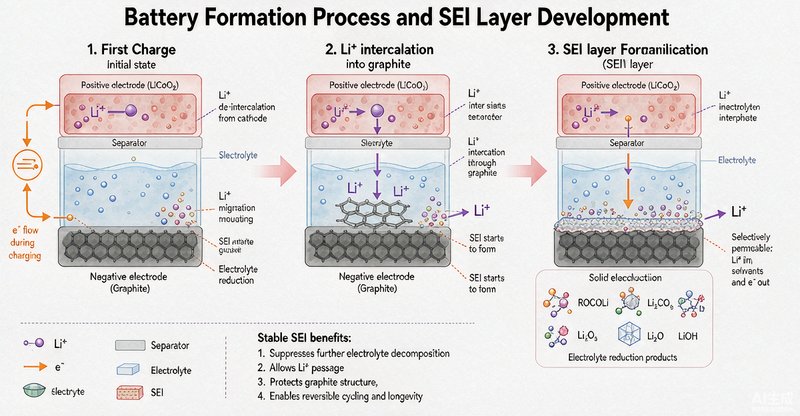
Sodium-ion batteries are moving from laboratory curiosities to commercial products. But testing Na-ion cells is not the same as testing Li-ion — the chemistry difference creates unique requirements for voltage range, formation profiles and safety protocols.
1. Voltage Range and Current Profile
Sodium-ion cells operate at a lower nominal voltage (~3.0 V) compared to Li-ion LFP (~3.2 V) and NMC (~3.7 V). The typical voltage window is 1.5–3.8 V. Cyclers designed for Li-ion's 0–5 V range work fine for Na-ion, but the lower operating voltage requires more precise measurement resolution at the low end. Current profiles are similar to LFP, with typical rates of 0.5 C to 3 C.
2. Formation Differences
Sodium-ion formation has a different profile than lithium-ion. The larger sodium ion radius means slower diffusion kinetics and longer SEI formation time. Na-ion cells typically require more formation cycles and longer rest periods between cycles. The formation voltage profile is also different — Na-ion cells often require multiple CV stages at different voltage plateaus to ensure complete activation.
3. Capacity and Energy Density
Na-ion cells have lower energy density than Li-ion (100–160 Wh/kg vs. 150–250 Wh/kg for NMC). Capacity testers and cyclers for Na-ion can operate at lower voltage and current per channel. However, the lower voltage means internal resistance testers need good resolution at low voltage levels. A cycler configured for 0–5 V with 1 mA minimum current works well for Na-ion cell testing.
4. Thermal and Safety Behavior
Na-ion cells are generally considered more thermally stable than Li-ion, with higher onset temperatures for thermal runaway. However, all battery chemistry can fail under abuse conditions. Safety test protocols (short circuit, thermal abuse, crush) are similar to Li-ion per IEC 62133 and UN 38.3, but the expected temperature profiles and failure modes differ.
5. Equipment Adaptation Requirements
Existing Li-ion test equipment can typically be adapted for Na-ion testing with software updates only. Key adaptations include: updating test protocol databases with Na-ion voltage profiles, adjusting formation algorithms for longer cycle times, and calibrating IR testers for the Na-ion resistance range. VoltTest's VT-CDS cyclers and VT-IR testers are all configurable for Na-ion through software.
6. Testing Recommendations for Na-ion Labs
Labs transitioning from Li-ion to Na-ion testing should: (1) update cycler software with Na-ion voltage profiles, (2) design custom formation protocols in consultation with cell manufacturers, (3) calibrate IR testers for the Na-ion resistance range, (4) verify safety test chamber temperature profiles, and (5) establish capacity and cycle life baselines for Na-ion cells.
12. Frequently Asked Questions
- ✓What is the typical accuracy requirement for my application? Most R&D labs require ±0.05% FS for cycle life testing. For production line QC, ±0.1% FS may be sufficient. Always match accuracy to your test requirements.
- ✓How often should test equipment be calibrated? Annual calibration is standard for most applications. Heavy-use labs (≥16 hrs/day) should calibrate every 6 months. ISO 17025 accreditation is recommended.
- ✓Can I use one system for both cells and packs? Yes, modular systems like VT-CDS can be configured with different voltage ranges. Ensure the cabinet has sufficient channel density and power supply capacity.
- ✓What about energy recovery efficiency? Modern regenerative cyclers achieve 90-95% energy recovery. This can reduce electricity costs by 60-80% during formation and cycle life testing.